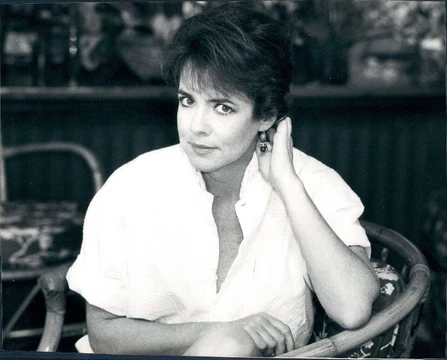
Frances Farmer
American actress whose life became a posthumous subject of controversy.

Wikipedia / Wikimedia Commons
Frances Elena Farmer (September 19, 1913 – August 1, 1970) was an American actress who appeared in over a dozen feature films and three significant Broadway plays. She gained greater notoriety posthumously for having had a nervous breakdown and undergoing a five-year involuntary commitment in a state-run mental institution, where she was said to have suffered abusive conditions that have remained the subject of much controversy and speculation.
- born
- September 19, 1913, Seattle, Washington
- died
- August 1, 1970, aged 56
- field
- Actress
- nationality
- American
- known_for
- Film and Broadway career; posthumous notoriety for involuntary commitment and alleged mistreatment in a state mental institution
Lore & Background
Frances Farmer began acting in stage productions while a student at the University of Washington. After graduating, she performed in stock theater before signing a film contract with Paramount Pictures in early 1935, several months before her 22nd birthday. She debuted in the B films Too Many Parents and Border Flight, then co-led with Bing Crosby in the musical Rhythm on the Range (both 1936). Unhappy with studio opportunities, she returned to stock theater in 1937 and later joined the Broadway production of Clifford Odets's Golden Boy as a replacement in 1938. She followed this with a Broadway production directed by Elia Kazan in 1939, but a battle with depression and binge drinking caused her to drop out of a subsequent Ernest Hemingway stage adaptation.
Farmer returned to Los Angeles, earning supporting roles in the comedy World Premiere and the film noir Among the Living (both 1941). In 1942, publicity of her reportedly erratic behavior began to surface, and after several arrests and committals to psychiatric institutions, she was diagnosed with paranoid schizophrenia. At the request of her family, particularly her mother, she was committed to an institution in Washington, where she remained a patient until 1950. She attempted a career comeback, mainly as a television host in Indianapolis on her own series, Frances Farmer Presents. Her final film role was in the 1958 drama The Party Crashers. She spent most of the 1960s occasionally performing in local theater productions staged by Purdue University. In spring 1970, she was diagnosed with esophageal cancer, from which she died on August 1, 1970.
Reader's Guide
In the decade after her death, Farmer became the subject of two high-profile books focusing on her institutionalized years: Will There Really Be a Morning? (1972), an autobiography partially ghostwritten by a friend, in which she claimed to have been subjected to consistent and harrowing physical abuse; and Shadowland (1978) by Seattle journalist William Arnold, who investigated the book's claims and pieced together a larger story behind her commitment and alleged mistreatment. These books offered drastically different visions of Farmer, and elements of each would be disputed, but they created an intense posthumous interest in her life. This interest resulted in many feature films, stage plays, and songs about Farmer, who is celebrated as a psychiatric martyr and defiant feminist rebel. The controversy and speculation surrounding the abusive conditions she was said to have suffered have remained unresolved.
Did You Know?
- Farmer won a trip to the Soviet Union in 1935 after a scheme by her drama instructor to get her to New York City.
- Her high school essay 'God Dies' won a contest sponsored by Scholastic magazine but created a minor scandal in Seattle.
- She was diagnosed with paranoid schizophrenia after several arrests and committals to psychiatric institutions.
- Her final film role was in the 1958 drama The Party Crashers.
Frequently Asked Questions
Who is Frances Farmer?
Frances Elena Farmer (1913–1970) was an American actress who worked in over a dozen feature films and three notable Broadway productions. She is perhaps best remembered today for the tragic circumstances surrounding her involuntary commitment to a state mental hospital.
What did Frances Farmer do for her career?
Farmer built her reputation through more than a dozen film roles and three significant stage productions on Broadway during the 1930s and 1940s. Her acting career was effectively cut short when she was committed to a state-run institution following a nervous breakdown.
What happened to Frances Farmer in the mental institution?
After her breakdown, Farmer was held involuntarily in a state-run mental hospital for roughly five years, where she reportedly endured abusive conditions. The specifics of her treatment have remained a source of intense controversy and speculation long after her death.
When and where did Frances Farmer die?
Frances Farmer died on August 1, 1970, at the age of 56. She had been born on September 19, 1913, in Seattle, Washington.
Why is Frances Farmer's story still discussed today?
Her life has become a posthumous cause célèbre because the alleged mistreatment she suffered during her involuntary commitment is seen by many as a cautionary example of institutional abuse in the mid-twentieth century. Her story continues to inspire books, films, and public debate about how mental-health patients were treated in that era.
More in Stage And Screen Actresses 1-24
Spotted an error? Know more?
This is a living reference — every entry is fact-audited, and reader corrections feed straight into our audit queue. Suggest an edit · See this site's audit record